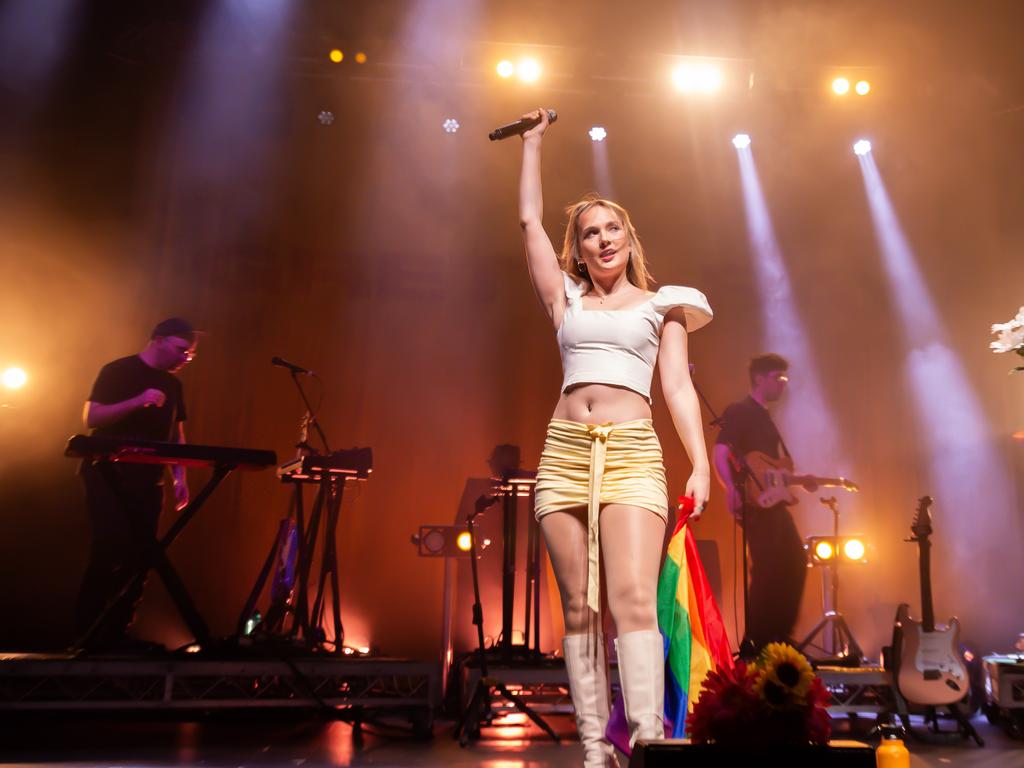
The Princess Theatre, Woolloongabba. Friday the 15th of September. The opening night of Gretta Ray’s The Big Pop Show, and the youths were out in full form. Brazenly decked out in pastels and primary colours, spinning in their high heels, the girls were euphoric: whole arms adorned in friendship bracelets, butterfly clips holstering fringes. Eyeshadow glittering with the luminescence of youth; more hopeful than naïve.
While prominent, this spectrum was by no means the median demographic. I was there with my 30-something friend in his usual attire of black on black on black. Naturally, I was in bellbottoms. There were a bunch of couples in their 40s in low-slung leather belts and saddle bags, and your typical Triple J clientele with the beige corduroy caps on indoors, paired with faded khaki Vans. Hordes of many kinds gathered to see the self-proclaimed pop girlie who has spent years working her way into the hearts of the Australian public. Despite still being only 24 years old, she’s well on her way to household name status – or so I sincerely hope. And amid the eclecticism of the faces in the crowd, the colour set the tone. Best emanated by the bright, flouncy skirts, the stiletto boots, the DIY beading on all the Gen Z wrists. And it was unabashedly cool because they said so.
I couldn’t ignore the impression that we are living through some sort of huge pop renaissance. In this “girlie” dominated climate, where young women refuse to be condescended to, listeners are being met with lyrical allure, heart-on-sleeve storytelling embedded in music that challenges us for the first time in what feels like decades. And Gretta Ray is nailing this intrepid and joyful divergence.
I’ve always been a cynic for pop music. I’ve thought that it wasn’t for me because, I craved some sort of deeper meaning or challenge in my formative teen-to-early-twenties years. I’m 25, so that means those years were peppered with the excessive radio play of Katy Perry and Meghan Trainor. And because I was a young woman in in my formative years, any affinity I had for Taylor Swift at the time had to be closeted from my main identity, as I couldn’t find the link between catchy and integrity. If your favourite song was going off at a primary school disco, that said something about you and your shallow taste.
But it feels like we’ve turned a corner. We’ve stopped composing to the lowest common denominator (the formula of how quickly can we possible latch this song into your brain??) and are now marrying sophisticated singer-songwriter sensibilities with the catchy pulsation of pop music – daring it into complicated textures and layers to diminish the ear-wormy factor that the “alternative” has begrudged for so long. Looking at the catalogue on offer today we’ve got Olivia Rodrigo (20), Maisie Peters (23), Sabrina Carpenter (24), Billie Eilish (21); and to a new degree, these young women seem in control of their output.
A lot of the discourse in Taylor Swift’s enduring decades of fame has centred around how you maintain your relevance in the inherently feminine space – a question her male contemporaries are rarely asked. What gimmicks of reinvention do you have to indulge to continue to be worthy of attention? But in a time where women, particularly our Gen Z ladies, are shedding layers of shame concerning what they love, why they love it, and how much they get to love it, there’s space for stories of honesty and authenticity in the headlines.
It’s hard to know who to credit for this chasmic revolution in popular sound: is it a leap in technology that enables an easier fusion of genre and risk-taking, or audience appetite for feminine storytelling that has emancipated us from the money-making, hooky, radio-pop era of Max Martin-esque repetition? Could it be both? In the journey from one epoch of pop music to another, there has been a dichotomy of scepticism between the version written in a bedroom for guitar and vocals and the finished product that coaxes us onto the dancefloor. One that we previously may have turned our nose up at, calling the high-energy beat-centric track a sell-out version of its richer, more authentic origin. But these days, this kind of music feels brave enough to explore the depths of personal narratives AND be a bop in the same iteration. No longer are we watching our female pop stars ask permission to take the risk of being seen or heard, but are putting their stories out there in a form they are celebrated for owning.
With an arsenal of great, earnest songs and a band to indulge her sophomore era’s sonic revelations, Gretta Ray marched into her spotlight on the Princess Theatre Stage in white knee-high boots, a yellow skirt, and a white crop top elevated by geometric shoulder pads which tousled her honey-blonde hair. I was transported back to my early people-pleasing years where I yearned for little more than to feel like I could own my sense of style, and that this could manifest with the confidence of shoulder pads! Immediately I was nostalgic for the ownership of oneself that at my most “girlie” years I felt I had to shy away from to be taken seriously. The confidence and ownership she wore on that stage sent waves of relief and epiphany through me.
To recapitulate a rant I’ve been on for months, I believe we’ve conquered a summit of a mountainous socio-cultural and media era. A torrent where every second day we were hearing the surprise and glee in yet another news report about how the Barbie movie’s opening weekend outdid box office projections tenfold, and how Taylor Swift ticket sales has revived the American economy. We are now living in a reformed media landscape where our default rebuttal to reports of “Sophie Turner is a bad mum” is “the media is unjustly framing this family conflict against the woman, and we just won’t swallow this anymore with proof or a damn good reason.” Empowered young women are the colossal force setting alight these huge social dynamos, driving economies and shutting down media discourse, and these women are also the ones who want to dress up in yellow, put on their retro go-go boots, make friendships bracelets and sing out earnestly every lyric to an album that was only released a month ago. Young women are eradicating the word guilt from its partnership with the word pleasure, and the girlies are wearing shoulder pads once again. Thank god.
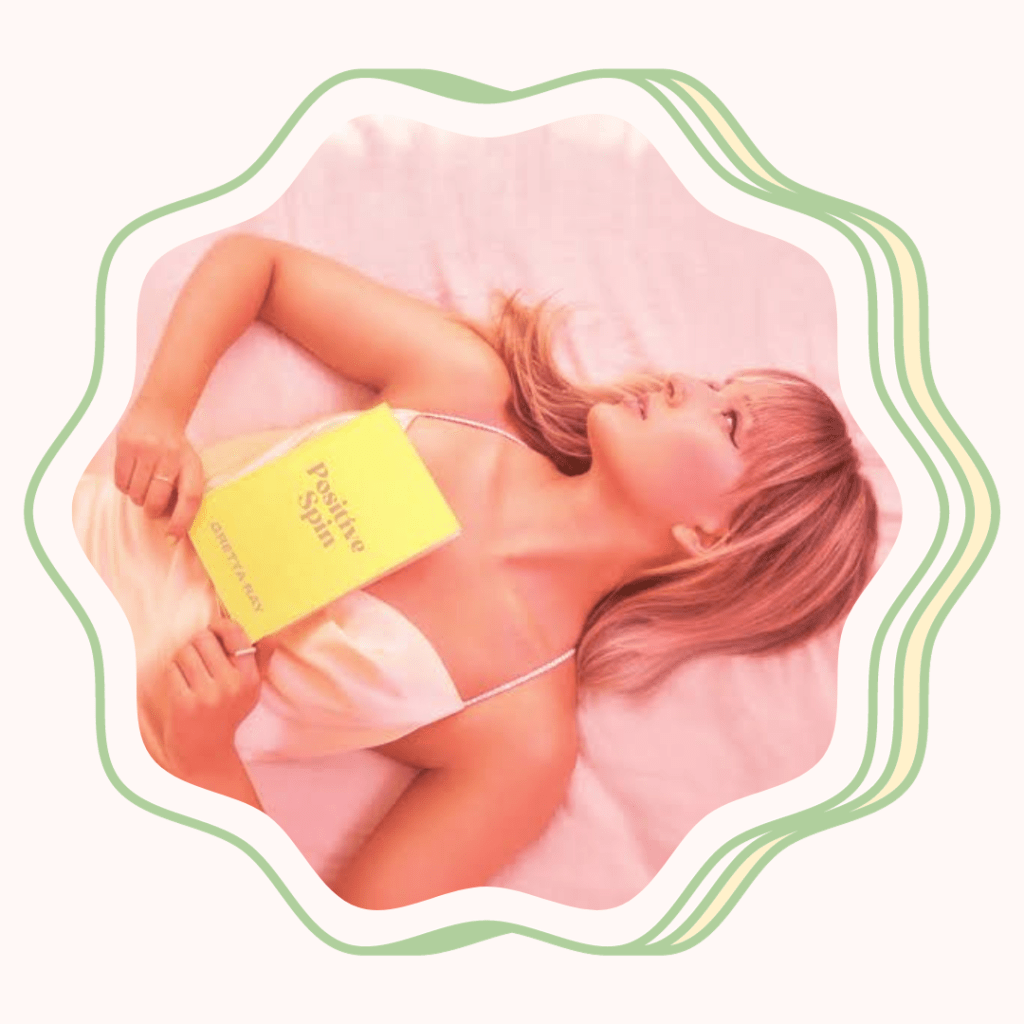
Positive Spin was released about a month before Gretta Ray commenced this tour. The vibe for the album was clear from the onset. Sunshine-and-daisies is an aesthetic that we can reclaim as elevating, no longer vapid and lacking dimension. It’s part of a brand that allows you to embrace and consume what makes you feel good, and this act of reframing is articulated in the title track: Positive Spin is littered with aphorisms that I would have scrawled on my bedroom wall at 17. It opens thus:
“Stretch marks on my thighs / So easy to spiral / Solely reading books by women / Preach them like the bible / I want to make a change / Be known as unique, fit the brief, make the grade all in a day”
Immediately, the hearts of her listeners are screaming YES and ME. In an era of social responsibility, where finally one can be a little silly and still deserve the soapbox, the anthems of self-improvement NEED to be ones we can dance to.
The first single released from this album was Dear Seventeen, a track geared to impale the lost and wandering 20-something, and rekindle a little hope with a smidge of perspective. This song brought together colours of Californian sunshine-pop muddling with her foundations of memoirist lyricisms on clean acoustic chords. I rinsed this song on repeat one August day, driving an hour up the coast, setting myself the challenge of singing through the climax of the fourth verse without my voice wavering into a sob,
“Your best friends stick around, your sister’s proud / And have no doubt you’re still obsessed with Taylor”.
It was weeks before I was successful.
The winsome melodic quality of Gretta’s early soft-alt music is ever present in this record: lilting on and off the beat in both satisfying and unpredictable ways, driving stories forward where it would often be easier to tie up a stanza in a neat little bow. The storytelling is vivid and empathetic. The tales of mistakes as they are happening or in retrospect serves to only garner more wisdom and credibility. Burgeoning romance
Combine this with her molasses vocal timbre, and gentle ease between her whispery and chesty registers, and it possesses a unique quality that both lulls and excites.
In the Princess Theatre that night, Gretta whirled us into a generous and euphoric performance with anthemic riffs for the chorus to chant along to, sharing the heart fluttering and sardonic proverbs of the songs she took effortlessly from bedroom to studio to big pop stage.
As the night drew close to its close and the crowd glistened with the sweat of a heartfelt heart-racing boogie, Gretta went on to share with us part of her journey. To paraphrase, she told us about the years she’d been pressed into the mould of the alternative, moody, serious and ethereal singer-songwriter, urged toward acoustic ambience and the lyrical nakedness that could break hearts. But on her sophomore album, after having dived into the deep end of the kaleidoscopic pop stratosphere, she played for us her most popular song, which ultimately is, was and has always been, “a big fuck off pop song.” People scream-sang and bounced along to her 2016 Unearthed High winning track Drive. A song that humbled me in reaching my top tracks of three consecutive years of Spotify wrapped. A spaced-out dream became a celebration, and it was clear Gretta has found her footing in a sound that has ached for the uniqueness she brings.
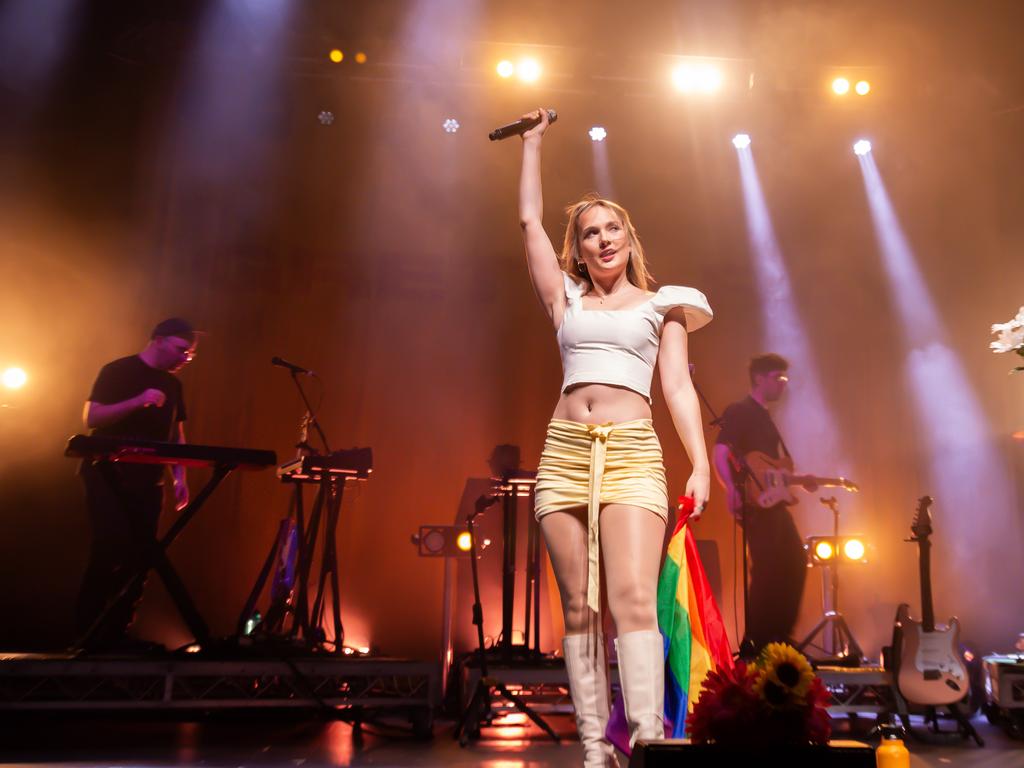
Photo credit: The Courier Mail

 The Unending Ode