I was in my share house kitchen with a flat mate, tidying up after a whimsical little dinner party where we pretended we were dining in some intimate trattoria somewhere on the west coast of Italy, and I’d performed the role of overbearing and overfeeding matriarch in our little weeknight Mediterranean fantasy. The ceiling lights were off, small tungsten lamps in stained glass shades were on, and we soundtracked the evening with almost every recorded version of The Girl from Impanena.
An hour or so later, I was paying the typical price of using almost every utensil in my kitchen to throw together a simple, traditional pasta, and arguing spiritedly in Italian with my bilingual housemate about who should wash the dishes and who should lovingly piss off and get a good night’s sleep – our favourite way to argue as you can raise your voice and vitriol, yet the tone never errs from adoring. It was then that Spotify spun us to the deep dark avenues of Andrea Bocelli singing “Vesti la Giubba.”
This triggered a memory in me, one I was eager to share. From the opera Pagliacci by Leoncavallo, I truly believe it to be a perfect work of poetic simplicity and musical climax. So we put the sponges and tea towels down and I sought out an iconic version of Pavarotti singing this particular song (unspeakably superior to Bocelli), and over the top of his performance I begin a dramatic reading of the words in the space between each phrase before he sang them, just as my dad does when he can’t contain his excitement enough to wait to sing the words in time.
I then started a conversation I’ve started a thousand times before, breathless like an eager kindergartener:
“Have you seen The Untouchables? That scene when Robert De Niro is Al Capone at the opera? Watching Pagliacci, that opera about the clowns? And the sad clown is singing about heartbreak and betrayal but also about painting a brave face? And the shots of the sad clown are interspersed with a bullet ridden Sean Connery commando crawling to save his own life? And Capone is sitting there smugly, sure he has won?”
This scene understands the traditions of drama in a way that sometimes only the most superlative art form, opera, can help articulate. So here’s a compilation of movie moments that capture that exact little bit of magic for me.
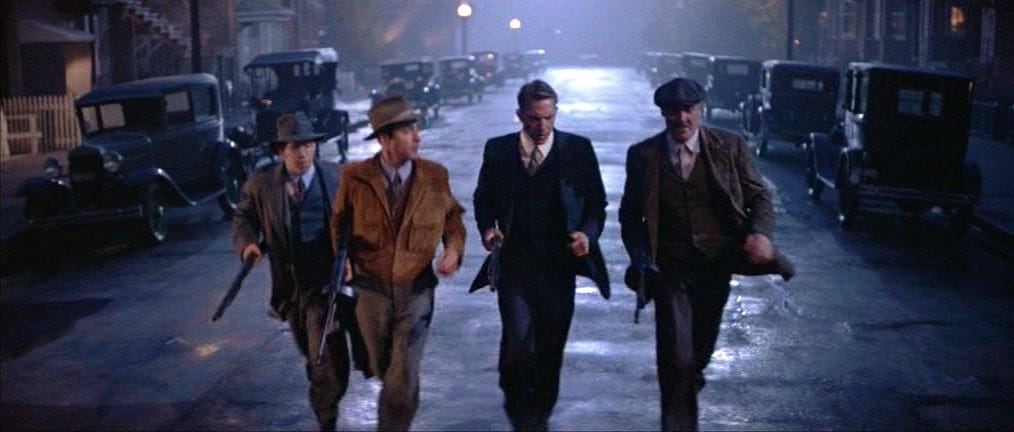
The Untouchables – Pagliacci’s Vesti la Giubba
This moment took my breath away when I first watched it, my love affair of movies just burgeoning, and my romance with opera years ahead of me. My mum and dad took me through the unspoken rituals of sharing “classics” with me, and dad had decided I was old enough to share with him what he regards the most iconic shoot out, with the slickest dialogue I’d ever heard: You got ‘im? Yeah, I got ‘im. Bang.
Watching the movie back years later, I was embarrassed to realise it could be read as a little trite and pulpy, overblown and undercooked. But its commitment to height and sensationalism, and its brassy, wise-guy coolness still sweeps me away.
In the supercut of Al Capone at the opera up against Maloney fighting for his life, the superlative language of Italian holds so much more power than the translation does, one I will write for you anyway:
Laugh, clown, at your broken love
Laugh at the pain that poisons your heart
Chills, I tell you. Chills.
The Godfather Part III – Mascagni’s Cavalleria Rusticana
In keeping with the theme of Italian mafia soapie melodrama, I gotta mention The Godfather Part III.
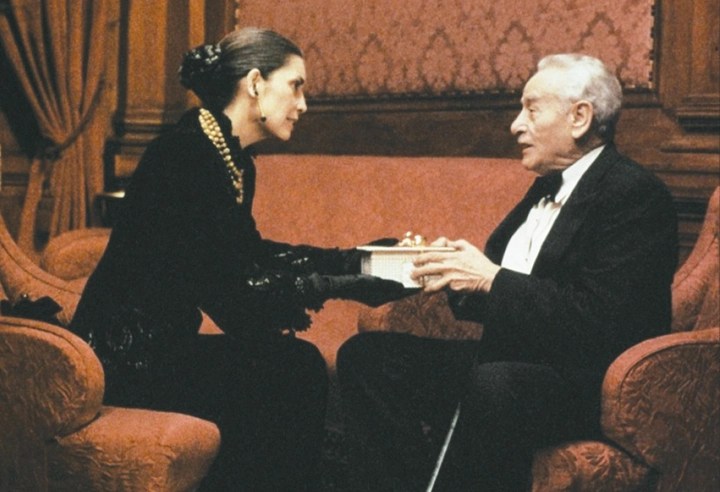
The Corleone family are in the foyer of the Teatro Massimo, setting schemes in motion to the sound of an orchestra tuning, dwelling on the most sinister representation of cannoli you’ll ever behold.
They watch Cavalleria Rusticana by Mascagni – an opera set in a rustic village of 19th century Sicily. This choice parallels the underdog mentality of the humble Sicilian; from rustic, poor beginnings, these migrant families have built formidable dynasties, and sat in the white ties and tailcoats upon red velvet upholstery to see their own stories told.
Anyone who has seen all three instalments of the Godfather knows that its final chapter falls short of the satisfaction gained from the first two – and I admit my biggest problems with it are Al Pacino’s hair looking too much like Reggie Belafonte’s in Surf’s Up (2007), and the casting of Eli Herschel Wallach, the quintessentially Jewish screen hero of who I know made his character acting career cosplaying Sicilians for Elia Kazan dramas and Sergio Leone’s Spaghetti Westerns – but who will always be to me the golden age Hollywood screenwriter neighbour in The Holiday (2006).
This scene leans into melodrama like nothing else. An insidious murder plot takes hold right at the musical climax of the opera’s most famous chorus. I am laughing, but I also can’t help but applaud.
Moonstruck – Puccini’s La Boheme
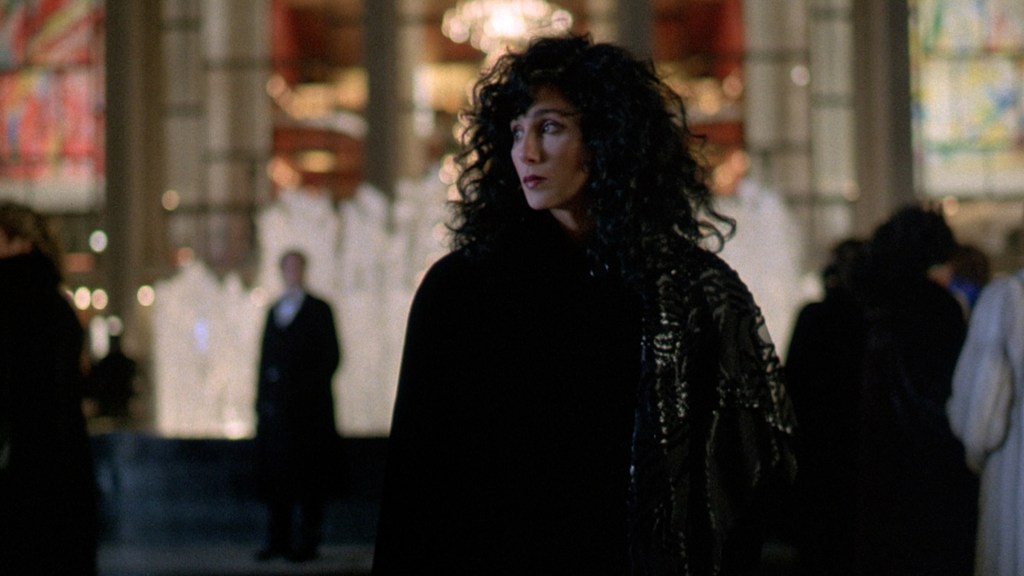
Much like how the Godfather’s opera scenes juxtaposed their humble roots against their self made glory, Moonstruck pits it the other way – the opera is an out of reach, impermeable place for the average working class New Yorker, and a night at the Met is a truly transformative and catalysing experience.
I will go to bat for this movie’s perfection on all fronts (including reminding anyone who will listen that Cher and Olympia BOTH won oscars for their performances, and that Nick Cage is hot in a wife beater.) The script and casting is utter, humble perfection.
Cher’s Loretta Castorini works at the family’s undertaking business, and Nick Cage’s Ronny Cammareri is a humble blue-collar baker, who idealises what might have been, how the other half live. The Metropolitan Opera in question doesn’t have the ancient unknowable opulence of Palermo, having been built only about twenty years before the this film was made, but brings an incomparable romance with its cascading sputnik chandeliers and towering Chagall tapestries.
As Mimi, the prima donna, sings a forlorn goodbye to her lover in the third act, she slowly raises a hand to shake his. In parallel, Ronny slowly brings Loretta’s hand to his mouth for a kiss. She turns to him with tears in her eyes. She doesn’t quite get it, and he might not either, but they are certainly feeling something, which is really kind of the point.
The candour and precision of the script bookends this moment perfectly. Loretta confesses at interval, “You know I like parts of it but I just don’t really get it.” And on the way out they discuss: “That was so awful.” “Awful?” “Beautiful, sad. She died! You know I couldn’t believe it.”
Pretty Woman – Verdi’s La Traviata
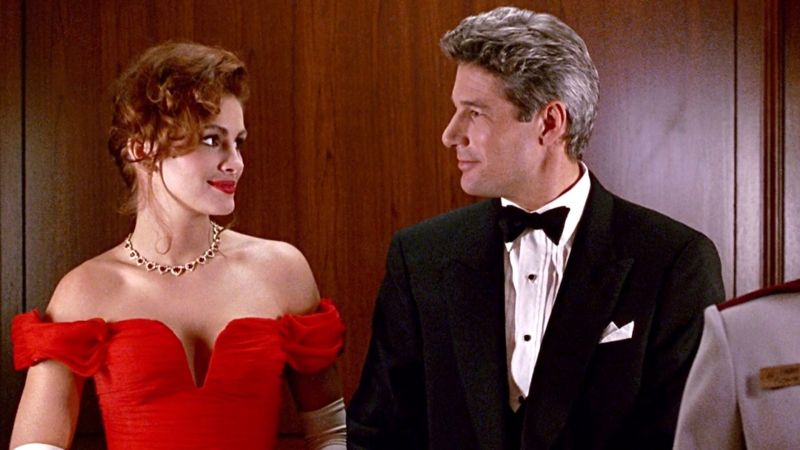
Garry Marshall’s magnum opus borrows plenty from operatic repertoire, and handles it with perfect subversion for the 80s. Edward and Vivian fly on a private jet to San Francisco Opera for opening night of La Traviata – opera’s seminal love story tragedy about a prostitute who is tormented by the choice between her love of life of her love of Alfredo. We fast forward through the opera, capturing the vocal acrobatics and the push and pull of the characters’ romance. It’s the most performed opera globally for a reason: the melodies are gorgeous. And Richard Gere is right: you don’t have to know what they’re saying for it to make total sense.
There is so much that makes for a wonderful moment: Julia Roberts’ hair, her dress! The way Richard Gere surprises her with a clap of the jewellery box! The surprise exclamation, “There’s a band!” There’s something new blossoming between them, and this scene captures it perfectly.
But the movie’s most heart wrenching moment is its recapitulation. Just when you think these characters have accepted their goodbyes and gone their own way, the impulse for a grand gesture kicks in and the whirling climax of “Amami Alfredo” soars as Richard Gere’s limo cruises through downtown LA. In perhaps the most satisfying resolution for them both, he asks, “And what happens after he rescuses the princess?” She replies, “She rescues him right back.”
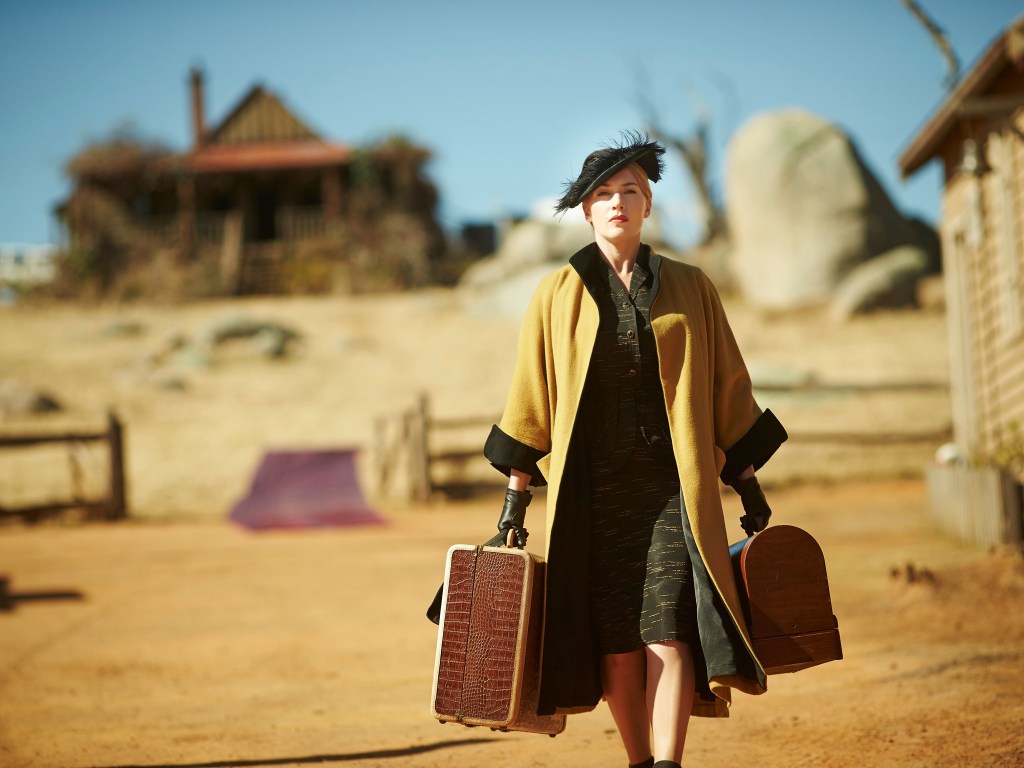
The Dressmaker – The Mikado’s Three Little Maids
One day I’ll write a list of my favourite movie endings. I adore being shocked by a grand finale. And I don’t discriminate on style, an ending that makes me cackle as much as this one did the first time I watched it belongs on the leader board with movies like Chinatown or Thelma and Louise all the same.
The Dressmaker understands small town Australia impeccably. Jocelyn Moorhouse has collaborated on some of the most ground breaking movies I know (Muriel’s Wedding, Mental), but she took the reins on The Dressmaker as director, writing the adapted screenplay with her husband PJ Hogan and the book’s author Rosalie Ham. This movie struck me with so much vision and style, with such an inimitable and intangible sense of irony.
It’s a story of revenge and rising from the ashes: Kate Winslet’s Tilly Dunnage has returned to her rural Australian town she fled from years earlier after a mysterious tragedy. She’s ready to right some wrongs and serve some comeuppance, armed with her Singer sewing machine and her repertoire of Parisian haute couture.
The chaos comes to a head at the end of the movie, following the local amateur theatre troupe to perform a kitschy scene from Gilbert & Sullivan’s the Mikado at a local eisteddfod in an artful use of juxtaposition. Upon a recent rewatch I lament that the score itself has aged poorly in 9 years – the mixing is imbalanced and the orchestration sounds a little stocky. But the drama, comedy, design, acting and direction holds up. Enjoy.
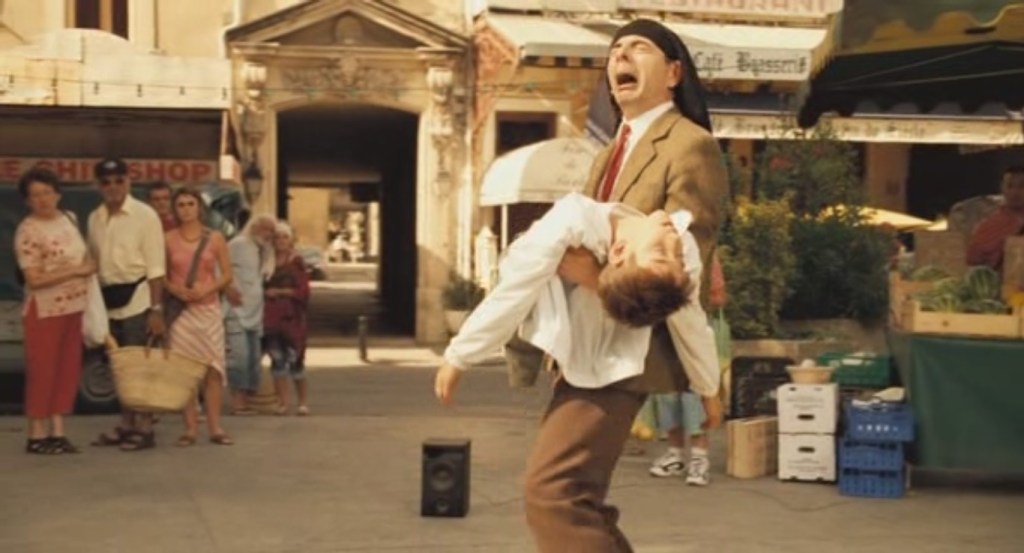
Mr Bean’s Holiday – Gianni Schicci’s O Mio Babbino Caro
Now I must confess, I have authority on this topic as I studied opera at university.
At my second year uni ball, a group of a hundred or so student musicians who all vaguely knew each other gathered in ball gowns on a terrace – something we did more often for our own performances than parties. The DJ was taking requests, and naturally, as us singing students leaned into the reputation of being ridiculous, obnoxious and the most fun, a friend of mine requested on of the genre’s most famous soprano arias, O Mio Babbino Caro. She then unfurled some napkins, and enacted the entire Mr-Bean-Busking skit like she’d watched it just yesterday. I promise you it brought the house down.
Nostalgia brings me back to Mr Bean every so often, amplified by my recent fascination that we have king of the modern rom com (Richard Curtis) to thank. I was squeamish at the cringe of it all as a kid, but in adulthood Rowan Atkinson’s jokes hold up as classy and self-aware. The physical comedy of a buffoon in a nice tweed suit mourning the death of a 10 year old kid with a napkin and some totally misinterpreted Puccini still has me giggling every time.
Anything I’ve missed? Let me know what you think! Subscribe below for more opinions, recommendations and suggestions! ❤

 The Unending Ode