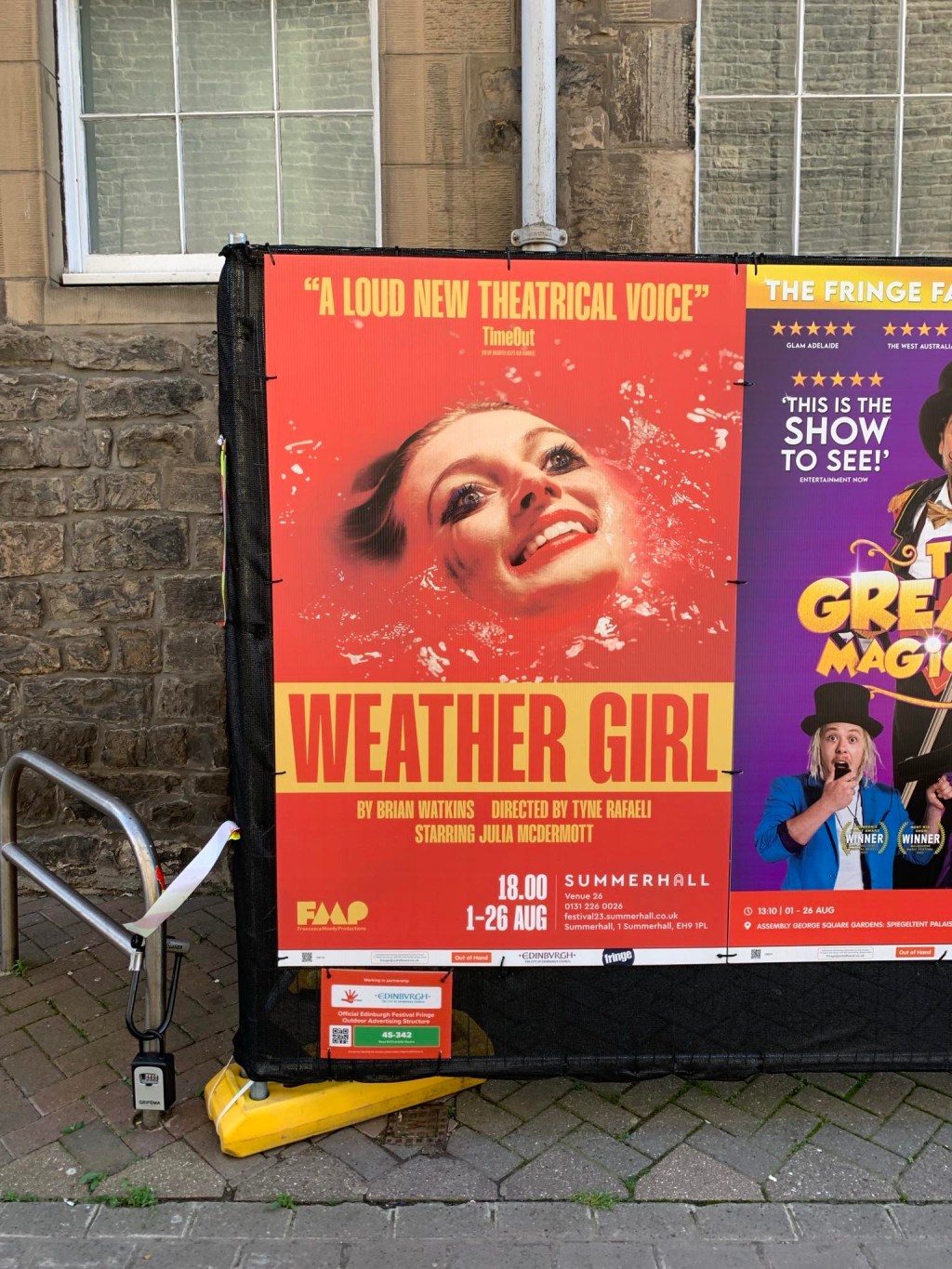
I felt so cocky going into the festival with tickets to see one of the month’s most anticipated and in demand events – a show that had sold out its season before august really even began.
Being in Edinburgh before the chaos really kicked off gave me my edge as a punter (however much my punishing work schedule compromised my follow-through). I loved watching the sombre, regal cityscape turn technicolour. My commute gave me a head-start on mentally programming my patronage as the posters went up, and I gleefully judged books by their covers. Weather Girl: a smiling face, moments from drowning – like Venice at the mercy of a magenta tide – with tracks of molten mascara streaming down her cheeks. Its byline had me locked in: “An oversexed and underpaid harbinger of our dying planet.” Harbinger – what a delicious word. I was hooked. I bought two tickets.
The one woman show was a breathless and dire revelation. An insidious and harrowing monologue decorated in a Stepford smile, the show was at first a parody of its own plastic precedent, bubbling with an undercurrent of white-hot-dark-americana reminiscent of Muholland Drive or Nightcrawler.
We meet Stacey at 4am in the Californian desert, the air hot with inexplicable sin. Made up like a doll, propaganda of optimism, she reports on a wildfire as it consumes a family home back to morning television co-hosts who mock her caricatured charm, as they cut from a cooking segment to her watered down and dolled up take on what the forecast means for the fate of local Californians. Barbecues!!! As Stacey sweats and wavers in her convictions over the course of the cataclysmic heatwave and a dangerous pursuit of her homeless, drug-addicted birth mother, she sheds layers of sunny-side-up rhetoric to the ashes and smoke, and her bright canary-in-a-coal-mine patter becomes a guttural, tidal wail.
It was suffocatingly well directed. The stage was laced in a tight perimeter of practical lighting: a ring lamp rigged under her chin, panels of fluorescence mimicking a studio, electric LEDs on booms, and dimmable tungsten to illustrate the gloaming of a dawn or a wildfire on the horizon. Scenes were spliced with sharp and immediate shifts in light and tone, carrying us breathlessly through the story.
Julia McDermott’s attack on the performance was like one of a scalpel; precise, sleek, subtle and injurious. Her tonal shifts were marked by excellent unfaltering vocal choreography; artfully soaring from a subverting quiver to foghorn. A dark Stanley-cup cocktail of alcoholism and hysteria upon a backdrop of environmental and social doom divorced our weather girl Stacey from moral accountability and reprehensibility. The tight fuchsia spandex kept the monologue spouting at high pressure which clawed its way through the audience’s consciences toward a surrealism; in dogged pursuit of a miracle.
The writing toyed with our faith. At once anarchic and belligerent and prophetic and exorcising. Funny. Self deprecating. Debauched. Wretched. A high octane journey through and toward purgatory and divinity, this play and this performance was a welcome reminder of the social utility of good art.
After the performance I bought a copy of the play script without hesitation. I needed to grapple with the blueprint that had managed to intoxicate me so. It opens with with an excerpt from an inimitable commentator on the setting, Joan Didion,
“California is a place in which a boom mentality and a sense of Chekovian loss meet in uneasy suspension: in which the mind is troubled by some buried but ineradicable suspicion that things work better here, because here, beneath the immense bleached sky, is where we run out of continent.”
As applause started, the reception took a moment to settle over us. I could feel palpable waves of “I don’t know how to swallow this,” pulsing through the lecture theatre. As I turned to grab my coat without spilling the beer I hadn’t taken a single sip of in over an hour, I noticed the young woman behind me convulsing with sobs into her partner’s chest. She caught my eye and tried to laugh, “I’m sorry, I’m from LA.” I turned to my sister to share a clandestine giggle and as we locked eyes, a wavering, unprecedented sob latched onto both of us. We couldn’t stop laughing, we couldn’t stop crying.
It was in this dignified state that Genevieve and I tried to hustle our way out of the theatre, only making it a few steps each time before having to ask the other, “Hold my beer while I wipe my face,”
We were breathless, speechless, and at a loss to explain what we’d underwent. Perched in a hidden corner of the Summerhall Courtyard, just past the Royal Dick, I laughed again delirious, “And, oh of course, there’s Phoebe,”
It’s hard to explain how much Phoebe Waller Bridge and her writing means to me, and I daresay I’m not the only one who’d claim so. I’ll skim the surface by telling you that I believe she’s the reason my sister and I are friends these days. Her illustration of sisterhood illuminated the preciousness of the bond between two women who are so different yet so inextricable. I think she taught me how to love my sister, and I believe she taught my sister how to stomach me.
I was so flustered by the chance to make a minute’s worth of giddy small talk with my hero that I didn’t get the chance to mention any of that. I also forgot to mention that for months when people had asked me what my plan was in moving to Edinburgh that I’d always respond with, “So I can be sitting in a cafe or a pub with a notebook or my laptop or a book, when Phoebe happens to walk past with a pint on her way to the neighbouring table, she asks what I’m working on and she’s enamoured by me and asks me if I want to be her muse,”
We did get to chat briefly about Weather Girl though. We took a moment to explain that our disheveled, teary state was not directly due to meeting her. She had seen it and said it was amazing. I was thrilled to agree with her.

 The Unending Ode